
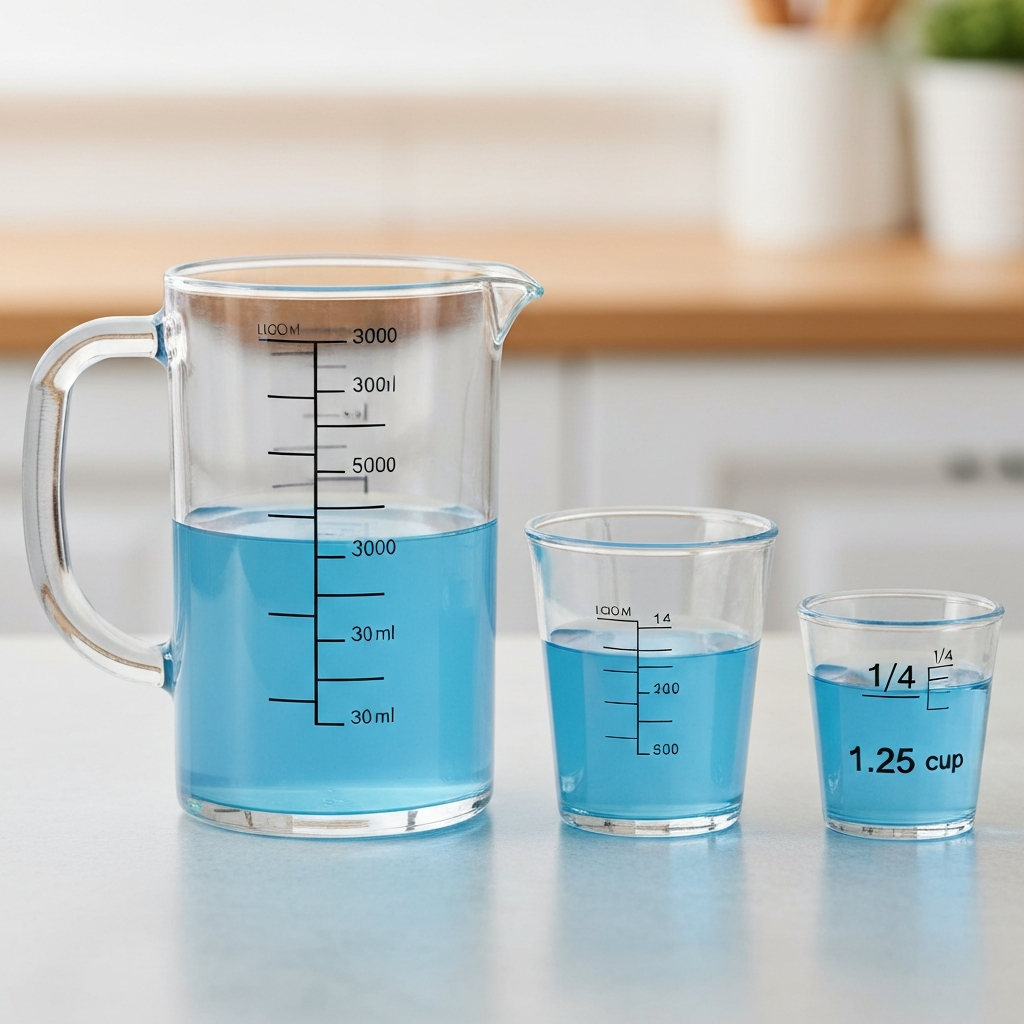
Understanding the Conversion
The conversion from milliliters (ml) to cups is a common need for home cooks and bakers worldwide. While the exact conversion can vary slightly depending on whether you are using US customary cups or metric cups, a widely accepted and practical conversion for cooking purposes is that 1 US cup is approximately 236.59 ml.
To figure out how many cups 300 ml is, you can perform a simple division. Divide 300 ml by the number of milliliters in one US cup (236.59 ml). This calculation will give you the approximate equivalent in US cups. For many common baking and cooking scenarios, especially when dealing with liquids, a good rule of thumb is that 300 ml is roughly 1.25 US cups. You can also find handy conversion charts or online calculators to assist you. For a quick reference, check out how to convert 300 ml to cups.
Why Accurate Measurement Matters
Precision in the kitchen, particularly in baking, is often key to achieving the desired texture and flavor. Ingredients like flour, sugar, and liquids, when measured inaccurately, can significantly alter the outcome of a dish. Understanding conversions like 300 ml to cups helps ensure you’re using the right amount, whether you’re following a recipe from a US-based cookbook or a European one. This attention to detail can elevate your culinary creations from good to great.
FAQs About Milliliter to Cup Conversions
Q1: Is 300 ml always exactly 1.25 cups?
While 1.25 cups is a very close and practical approximation for 300 ml in most recipes, the precise mathematical conversion is slightly different. Using 236.59 ml per US cup, 300 ml is closer to 1.268 US cups. For most home cooking, the 1.25 cup estimate is perfectly acceptable.
Q2: What is the difference between a US cup and a metric cup?
A US customary cup is defined as 236.59 milliliters. A metric cup, often used in countries following the International System of Units, is standardized at exactly 250 milliliters. This difference is significant when converting recipes.
Q3: How can I easily convert ml to cups if I don’t have a calculator?
Many kitchen tools, like measuring cups and jugs, have both metric (ml) and imperial (cups) markings. Keeping a conversion chart handy in your kitchen or using a reliable recipe app can also be very helpful. Websites dedicated to cooking and baking often provide these conversion tools.
Q4: Do I need to be this precise for all recipes?
For baking, especially cakes, pastries, and bread, precision is generally more critical. For savory dishes, like stews or sauces, there’s often more flexibility, and slight variations in measurements are less likely to affect the final result. However, understanding the conversion for 300 ml to cups, or any measurement, ensures you are following the recipe’s intent as closely as possible.